
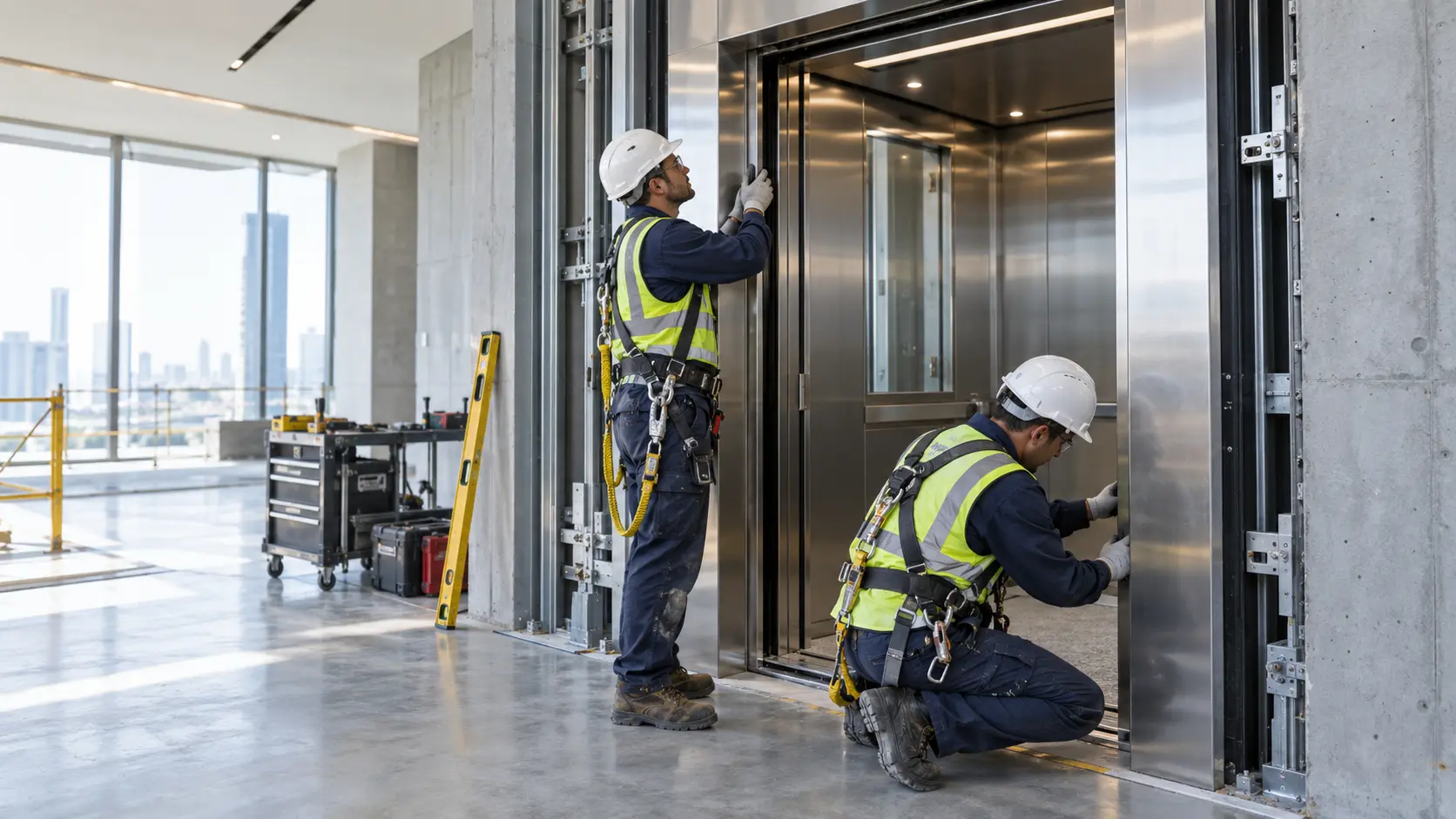
Installing a passenger lift is a complex engineering process that requires accurate planning, skilled technicians, proper coordination and detailed safety testing. Every stage—from the initial site assessment to final commissioning—directly affects the lift’s safety, performance, reliability and service life.
Understanding the passenger lift installation process helps building owners, developers, consultants and contractors plan their projects effectively and avoid costly delays. At Space Systems & Installation, we provide professional lift and escalator erection services for residential, commercial, public and industrial buildings across the UAE, Saudi Arabia, Oman and India.
What Is Passenger Lift Installation?
Passenger lift installation is the process of assembling, positioning, connecting, testing and commissioning an elevator system within a building. It involves the installation of guide rails, landing doors, lift machinery, electrical components, control systems, safety devices and the passenger cabin.
The exact installation method depends on several factors, including:
- Building height and number of floors
- Lift capacity and rated speed
- Shaft dimensions
- Machine-room or machine-room-less configuration
- Type of passenger lift
- Building usage and expected traffic
- Project-specific technical requirements
A professionally managed installation ensures that all mechanical, structural and electrical components work together safely and efficiently.
1. Site Assessment and Project Planning
The first stage of the passenger lift installation process is a detailed site assessment. The installation team reviews the approved drawings, shaft dimensions, pit depth, overhead clearance, landing openings and available working space.
The team also assesses site access, equipment-delivery routes, power availability, storage areas and safety requirements.
Effective planning at this stage helps identify possible problems before physical installation begins. It also allows the lift contractor, building contractor, electrical team and other trades to coordinate their work correctly.
2. Technical Drawing and Specification Review
Before installation starts, the technical team studies the lift layout, structural drawings and manufacturer specifications.
Important details reviewed during this stage include:
- Lift shaft dimensions
- Guide-rail positions
- Landing-door openings
- Machine and controller locations
- Electrical power requirements
- Load capacity and travel distance
- Pit and overhead measurements
- Equipment fixing points
- Emergency and safety provisions
Any difference between the drawings and actual site conditions should be resolved before the equipment is installed. This reduces rework, installation delays and alignment problems.
3. Lift Shaft Preparation
The lift shaft must be ready before installation begins. The installation team checks whether it is clean, accessible and free from unnecessary obstructions.
The shaft is inspected to confirm that its dimensions and vertical alignment match the approved specifications. The lift pit, landing openings and overhead area are also examined.
Suitable working platforms, temporary lighting, access arrangements and fall-protection systems may be required to create a safe working environment. Proper shaft preparation is essential because even small dimensional or alignment issues can affect the installation of guide rails, doors and the lift cabin.
4. Delivery and Inspection of Lift Components
Lift components are delivered to the project site according to the installation schedule. These may include:
- Guide rails and brackets
- Lift car frame and cabin panels
- Counterweight components
- Landing and car doors
- Traction machine or hydraulic equipment
- Control panel and electrical wiring
- Ropes or belts
- Safety gear and buffers
- Operating panels and indicators
Each component should be inspected for damage, missing parts or incorrect specifications before installation. The equipment must also be stored securely to prevent exposure to water, dust, impact or unauthorized handling.
5. Installation of Guide Rails
Guide rails control the vertical movement of the lift car and counterweight. They must be accurately positioned, aligned and secured inside the lift shaft.
Technicians install rail brackets at the specified locations and carefully check the vertical alignment of the rails. Incorrect guide-rail alignment can lead to vibration, noise, uneven movement and premature wear.
Because guide rails are critical to both lift performance and safety, this stage requires accurate measurement and experienced installation personnel.
6. Installation of Landing Doors
Landing doors are installed at every floor served by the passenger lift. The frames must be correctly positioned and aligned with the shaft opening and finished floor level.
The installation normally includes:
- Door frames
- Door panels
- Sills
- Hangers and rollers
- Interlocking mechanisms
- Door-operating components
Landing-door interlocks are an important safety feature. They help prevent a landing door from opening when the lift car is not correctly positioned at that floor.
Door alignment should be checked carefully to ensure smooth operation and consistent clearance at every landing.
7. Installation of the Lift Machine and Drive System
The lift machine moves the car between floors. Depending on the lift design, the project may use a traction, hydraulic or machine-room-less system.
For a traction lift, this stage can include installing:
- Traction machine
- Machine bed or support structure
- Drive sheave
- Ropes or belts
- Brake system
- Counterweight arrangement
The machine must be securely positioned and accurately aligned. Incorrect installation can affect ride quality, braking performance, energy efficiency and the long-term reliability of the lift.
8. Lift Car and Counterweight Installation
The lift car frame is assembled inside the shaft and connected to the guide system. The cabin floor, walls, ceiling, operating panel, lighting and finishing components are then installed.
The counterweight is assembled separately and balanced according to the lift design. Its purpose is to offset part of the lift car’s weight, reducing the effort required from the drive system.
Accurate installation of the car frame and counterweight is essential for stable movement, passenger comfort and efficient operation.
9. Electrical and Control-System Installation
After the major mechanical components are installed, technicians complete the electrical and control work. This connects the drive system, doors, operating panels, indicators, sensors and safety devices.
The work may include:
- Main controller installation
- Power and control wiring
- Car and landing operating panels
- Floor indicators
- Door sensors
- Emergency alarm and communication systems
- Limit switches and position sensors
- Emergency lighting
- Earthing and electrical protection
All connections must follow the lift manufacturer’s specifications and the approved project requirements.
10. Lift Cabin Finishing
Once the lift car is mechanically complete, the cabin finishes are installed. Depending on the building and customer requirements, the cabin may include stainless-steel panels, glass features, decorative ceilings, handrails, mirrors, flooring and custom lighting.
Space Systems & Installation also provides interior fit-out and turnkey solutions that can support the coordination of lift areas with the surrounding building interiors.
Cabin finishes should be completed without interfering with the lift’s door clearances, sensors, controls or ventilation.
11. Testing and Safety Inspection
Testing is one of the most important stages of the passenger lift installation process. The complete system must be inspected and tested before it is approved for normal passenger use.
Testing may cover:
- Lift movement and floor levelling
- Door opening and closing
- Landing-door interlocks
- Emergency-stop functions
- Alarm and communication systems
- Braking performance
- Safety gear operation
- Load performance
- Ride comfort, vibration and noise
- Floor indicators and operating buttons
- Emergency lighting and backup features
Any faults identified during testing must be corrected and retested. The lift should not be handed over until the required safety and performance checks are successfully completed.
12. Final Commissioning
Commissioning confirms that the passenger lift has been installed correctly and is ready for operation. The installation team performs final adjustments, verifies system settings and records the relevant test results.
Final commissioning can include:
- Reviewing the completed installation
- Checking mechanical and electrical systems
- Running the lift through its full travel
- Testing normal and emergency operations
- Confirming floor levelling and door performance
- Completing required inspection documentation
- Conducting the final handover
Depending on the project location, approval from the relevant authority or an authorized inspection body may also be required before the lift is put into public use.
Why Professional Passenger Lift Installation Matters
A passenger lift is used daily by residents, employees, customers and visitors. Installation errors can affect passenger safety, ride quality and equipment life while creating future maintenance problems.
Choosing an experienced passenger lift installation company provides several benefits:
- Accurate equipment positioning and alignment
- Better coordination with other contractors
- Reliable safety-system installation
- Smooth and comfortable lift movement
- Reduced risk of installation delays
- Proper testing and commissioning
- Improved long-term system reliability
- Professional project handover
The lowest installation price is not always the best option. Technical experience, safety procedures, project management and installation quality should be considered when selecting a contractor.
Choose Space Systems & Installation
Space Systems & Installation manages lift projects from initial site measurements and technical planning through equipment positioning, assembly, testing and final commissioning.
Our lift and escalator erection team works with a strong focus on installation accuracy, safety, reliability and timely completion. We support passenger lift projects across the UAE, Saudi Arabia, Oman and India.
If you are planning a new passenger lift installation or require professional support for an upcoming project, contact Space Systems & Installation to discuss your technical requirements.
Frequently Asked Questions
How long does passenger lift installation take?
The installation period depends on the number of floors, lift type, equipment specifications, site readiness and project complexity. Delays in shaft preparation, power supply or coordination with other trades can affect the schedule.
What should be completed before lift installation starts?
The lift shaft, pit, landing openings, overhead area, access route and electrical provisions should be prepared according to the approved drawings and manufacturer requirements.
What happens during lift commissioning?
During commissioning, the installation team inspects the complete system, performs operational and safety tests, makes final adjustments and confirms that the lift is ready for handover.
Why is guide-rail alignment important?
Correct guide-rail alignment supports smooth lift movement and reduces vibration, noise and uneven wear. Poor alignment can affect both passenger comfort and system performance.
Does a new passenger lift require safety testing?
Yes. A new passenger lift must undergo appropriate operational and safety testing before being placed into service. The exact inspection and approval requirements depend on the project location and applicable regulations.